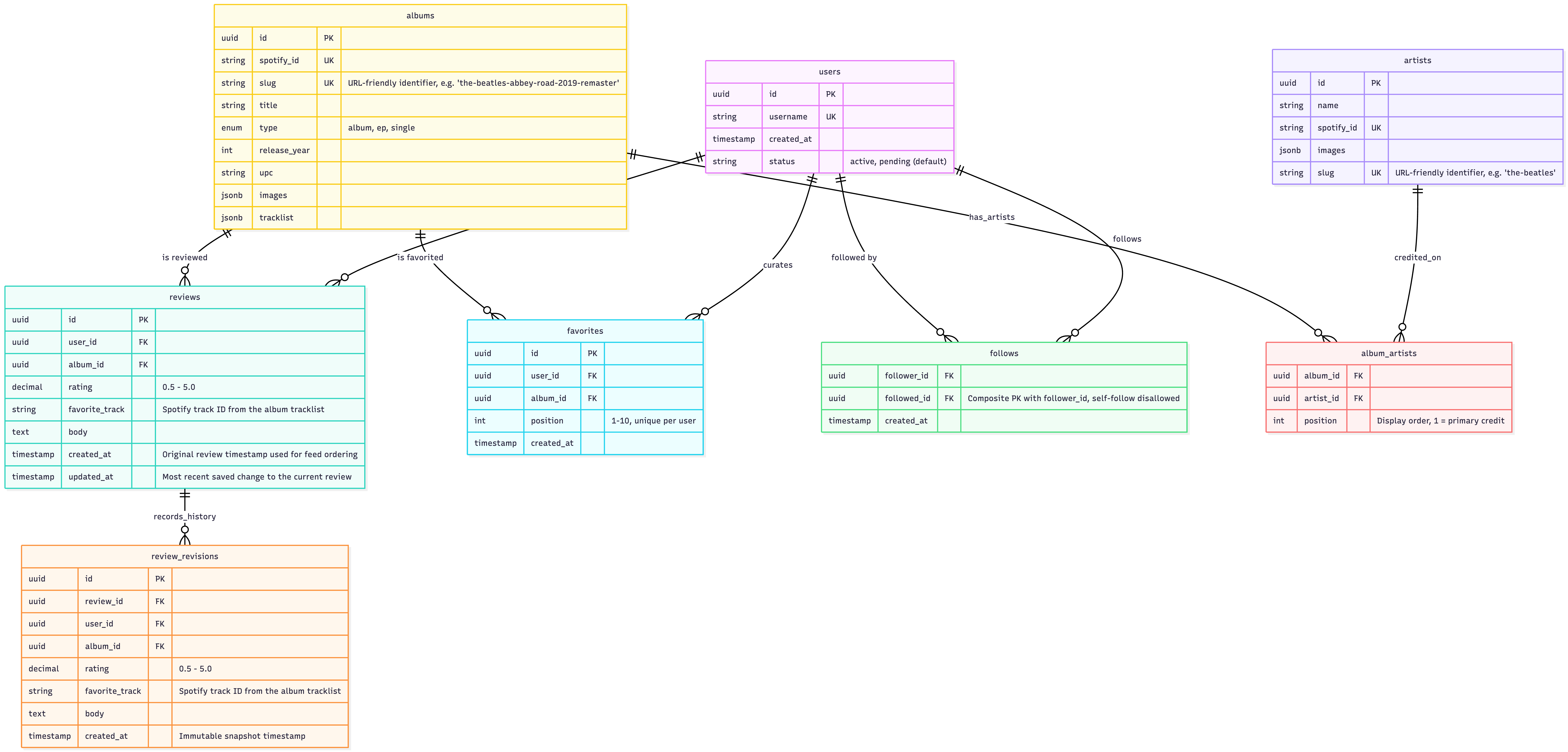
On my previous post, I had detailed the data model that I was to use for Spinlist. One of the complexities of the data model came from an attempt to "prevent data fragmentation".
Concretely, I created the data model in an attempt to have multiple album versions, (think re-issues, deluxe versions, etc) all fall under the same release group rating. In the product, this would look like User A leaves a rating on Noah Kahan's The Great Divide and User B leaves a rating on Noah Kahan's The Great Divide (Deluxe). These two rating would contribute to the same "release group".
This came out of an assumption that I had about what the user would want and so that led to what was a bit more of a complex data model than I would have hoped for.
After speaking to some potential users, to my surprise, the consensus was that No, each version of an album release should be treated independently. Some direct feedback I got was:
- To me, a deluxe version of an album could change my perception of the album.
- Sometime artists re-record the albums that completely changes how the work feels (for better or worse).
- I've had times where I found the original release to be perfect, and the deluxe version adds songs that feel out of place.
So there you go, it's so important to talk to your users as early as possible instead of making what could be incorrect assumptions of what the users want.
For the technically curious, this conversation led to a simplification of the data model (always a good thing in my opinion).
Here is the updated and much simpler version now. We'll call it v3. Third try's the charm right?